
Commencement & Commitment: A Staff Q&A with Our Graduating Colleagues
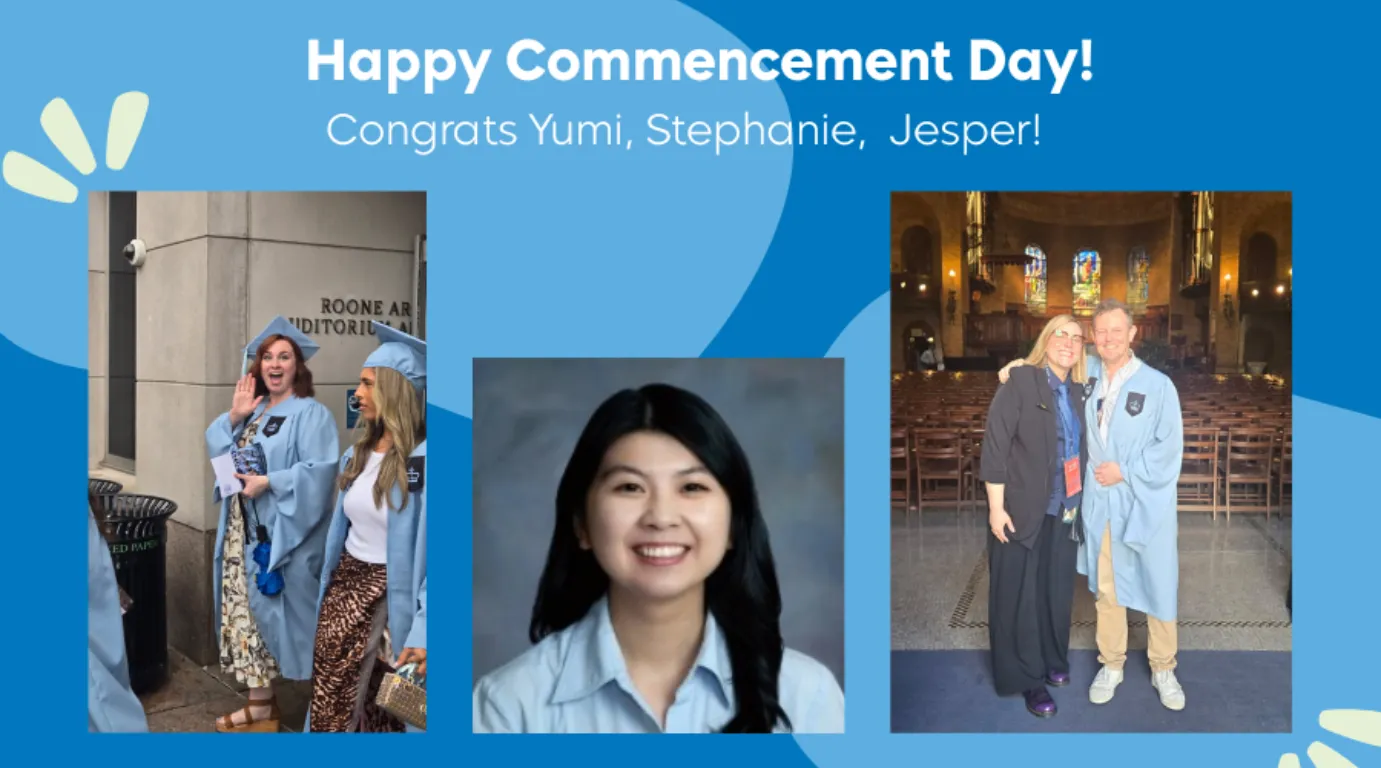
This year’s commencement holds many remarkable moments for students across the campus. From last-minute photos to final exams, ironed gowns, and decorated caps, many are celebrating achievements and looking ahead.
Among those graduating are three University Life staff members who have experienced University Life from both sides of the aisle. These employees have not only supported the Columbia community through their roles, but also spent late nights in class, early mornings at work, and years balancing both. Now, they’re crossing the stage not just as staff—but as graduates.
Yumi Otsu (Assistant Director, Operations and Student Outreach, CSSI); Stephanie Busch (Associate Director for Student Life), and Jesper Norgaard, (Assistant Director, Facilities, IT & Operations) are all receiving degrees this commencement season.
Read on to learn how these three dedicated graduates balanced their professional and academic lives—and what’s next for each of them.
Q. What degree are you receiving?
Yumi: I am graduating with a Master of Arts in Higher and Postsecondary Education from Teachers College.
Stephanie: A Master of Science in Negotiation and Conflict Resolution from the School of Professional Studies.
Jesper: I am receiving my undergraduate degree in psychology.
Q. What inspired you to pursue a degree while working full-time?
Yumi: When I started working at Columbia, I was a new professional in general and was so new to the field of Higher Education. My goal has been and still is to have made many impacts on students who needed assistance and to assist in creating a learning environment that is conducive to each student's needs, allowing students to have an enriching, fulfilling, and rewarding college experience. Therefore, I thought that pursuing a degree in Higher Education would help me to deepen my knowledge of the history, structure, and various aspects of higher education, and ultimately put that learning into practice.
Stephanie: I wanted to apply to this program because conflict scared me. I often felt unprepared when facing interpersonal tensions, afraid of saying the wrong thing, unsure how to move forward. That discomfort became a driving force. I wanted to better understand conflict, not just on a personal level, but in broader social and global contexts. This program offered a way to build a toolkit for navigating difficult conversations, practicing peacebuilding, and engaging more confidently with the complexities of human relationships.
Jesper: To begin, I decided to change my career path from photography to mental health counseling, which required me to first get a bachelor's degree before applying to grad school. I began my studies while working as an independent fashion, portrait, interior, and product photographer, which allowed me a little more freedom to take classes. I tried as much as possible to schedule my photography jobs around my class schedule, as it is impossible to take all classes in the evenings, and no weekend classes are offered. I returned to a full-time position at University Life this past January for my final semester. I plan to continue working full-time in my position as I begin my master’s degree at Teachers College.
Q. How has your education influenced or enhanced your work in this division?
Yumi: Through my coursework and classroom discussions, I gained valuable insight into student development theories, systemic inequities, and institutional structures that shape the student experience. This knowledge has strengthened my ability to support students in more meaningful, informed, and inclusive ways. It has also deepened my awareness of how programming, outreach, and campus support services can be designed to truly meet students where they are. I hope that I can continue to develop programs and initiatives at CSSI that reflect the diverse needs of our student population, and to advocate for practices that foster Student Success, Integrity & Accountability, and Community & Engagement.
Stephanie: Conflict is everywhere. We see it every day. This program offered me the chance to learn negotiation, mediation, restorative practices, analyzing and mapping conflict dynamics, and most importantly, how to ask good questions. I use all of these things in my daily work in student affairs, but they are also something that I hope to continue to develop throughout my career.
Jesper: I have worked with many different kinds of professional teams involved in various professions, from construction crews, corporate finance managers and lawyers, fashion stylists, hair and make-up people, to music and movie celebrities. The familiarity with the different psychologies in those areas has prepared me to work within the very different atmospheres and work environments that exist in the departments at Columbia.
Q. What was the biggest challenge you faced balancing work, school, and personal life, and how did you manage it?
Yumi: The biggest challenge was finding the time to sit down and do my class work. Often, my schedule would be back to back to back, finding the time to do my school work was challenging. However, I was fortunate to have a strong support system—friends, family, and especially co-workers—who consistently encouraged me and reminded me to take things one step at a time.
Stephanie: My biggest challenge actually came from my biggest goal for the program: to complete all of the required readings. In my first master’s program, I left feeling like I had missed out on key knowledge simply because I couldn’t get through all the material. This time, I was determined not to let that happen again (even though this time I was working full-time). Finding ways to multitask made this goal a lot more manageable, and I am proud to say I finished almost everything.
Jesper: Siloing the demands from the three aspects in my daily life remains a challenge. Prioritizing what is most urgent and important helps me manage my time and relieve anxiety and stress from being faced with mountains of tasks and responsibilities. Somehow, balancing looking only a few steps ahead while keeping awareness of the overall scope of a semester-length period has been crucial in completing this challenge. Finding time to exercise has been very important to maintain physical well-being and de-stress is among the most helpful and important choices I can make for keeping myself focused and healthy.
Q. Were there any standout moments, projects, or professors from your program that left a lasting impact?
Yumi: I enjoyed taking a class called The American College Student, which explored how different students experience college in the United States, considering factors like college preparation/access, campus life, and post-college outcomes through lenses such as race, gender, social class, and institutional type. The course encouraged me to reflect on my college experience, and thought about the different types of support I received from friends, professors, and the institution. My hope is that I can continue to support students at Columbia to succeed academically, personally and professionally.
Stephanie: Ultimately, it was the professors who made the most lasting impression. Just to name a few: Amy Sereday, my professor for Fundamentals of Ombuds Practice, has directly inspired my future career goals. Peter Dixon, the new Program Director and my Capstone 3 instructor, was not only one of my favorite professors but also someone who helped me grow as a writer and deepen my understanding of resolution strategies. Jenny Besch sparked my love of mediation and gave me some of the most valuable advice I've received about engaging with people in conflict. They were flexible when it mattered, demanding when it counted, and always in our corner. I truly loved this program and the people I got to learn from.
Jesper: There were several psychology professors whose courses in culture, prosociality, social justice, and neuroscience that left what I like to believe will have life-lasting impacts on me. Moreover, anthropology and sociology courses expanded my understanding of psychology, human behavior and social interactions. The core classes in music, creative art, and literature further expanded this understanding and helped foster continued curiosity and desire to learn about cultures.
Q. What advice would you give to colleagues considering going back to school?
Yumi: My advice is to take it easy and know your limits. There were moments when I had so much on my plate that I would barely have the time to read for class. It's a big commitment, and while it's exciting to learn and grow, it's also important not to get overwhelmed. Balance is key—especially if you're juggling work, personal life, and other responsibilities. Don’t be afraid to take fewer courses at a time if that helps you manage the load more effectively.
Stephanie: First, find the tools that work for you. For me, the audiobooks of my textbooks were a game-changer. Second, as an old colleague reminded me during one of her presentations, learn which balls are made of glass and which ones will bounce. If you can’t do everything, figure out what truly needs your energy, and then ask for forgiveness if needed. Finally, a piece of advice from my current supervisor was something her friend lives by, and helped me push through my most recent final papers, the last of my program, when I felt like I had no mental bandwidth left: embrace good enough. It’s a great mantra for those moments when you’re really struggling, because you will. Grad school is not easy, but it is worth it. Sometimes, we just have to accept that things won’t be perfect, and that’s ok.
Jesper: If you can find the time and have the support from your immediate family and close social groups, please go back to school. It is well worth the effort and will benefit your own cognitive health and development for the rest of your life.
Q. Now that you've earned your degree, what's next for you professionally or personally?
Yumi: Professionally, I plan to continue my work at CSSI, where I love engaging with students and helping them access the resources they need through tabling events and outreach. Personally, I’m excited to return to my hobbies—visiting cafes, playing golf, spending time with friends—and to reconnect with those I haven’t seen in a while. I also look forward to traveling more with friends and family.
Stephanie: My next goal is to be accepted into a mediation apprenticeship. I hope to start volunteering as a mediator and, eventually, be added to a court roster. I feel really called to mediation and helping people have difficult conversations. I hope that these new experiences will only improve my ability to work in higher education student affairs.
Jesper: I am continuing in grad school to complete my move to a new profession of mental health counseling. I plan to continue working in this new career until nobody wants to talk with me anymore, and I have helped the last person I can with their mental health and well-being.